Fire Resistance Performance
Ensure your project meets modern fire safety codes with tested and certified fire-resistant aluminum windows, doors and curtain wall systems.
What Is Fire Resistance?
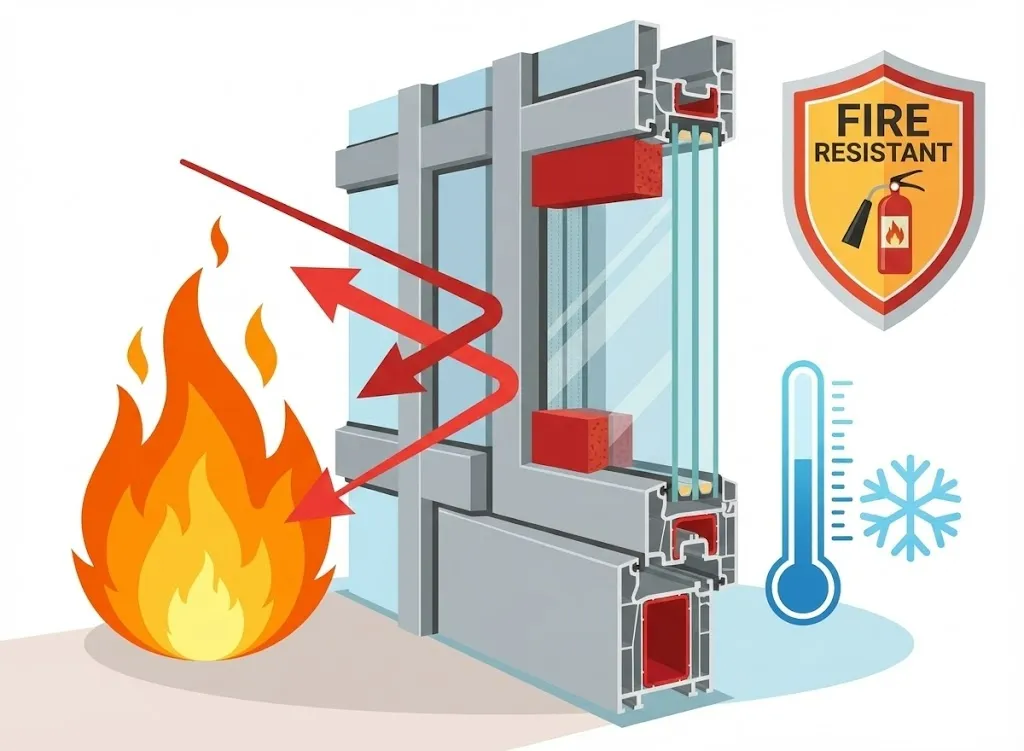
Fire resistance is a window, door or curtain wall system’s ability to maintain its integrity and, where required, insulation when exposed to fire. It helps slow down fire spread between compartments and protects escape routes and critical areas of the building. Key features include:
Fire-Rated Glazing – Special glass compositions resist flames and hot gases and, for EI classifications, limit the temperature rise on the safe side of the glass.
Fire-Resistant Frames – Engineered framing systems with protected cores and anchors maintain structural integrity around the opening during a fire.
Intumescent Seals & Gaskets – Heat-activated seals expand to close gaps between glass, frame and wall, blocking flames and smoke leakage.
Tested System Interfaces – Perimeter details, brackets and spandrel areas are designed and tested as part of the complete fire-rated assembly.
Benefits:
Slows horizontal and vertical fire spread across the façade
Protects escape routes, stair cores and refuges from flames and smoke
Helps projects comply with local fire codes and insurer requirements
Provides more time for safe evacuation and fire service intervention
How Our Doors, Windows, and Curtain Wall Systems Deliver Fire Resistance
Our fire-rated aluminum door, window and curtain wall systems are engineered as complete assemblies to help contain fire, protect escape routes and support code-compliant façades.
Instead of testing single components, our fire-rated systems are designed and classified as complete assemblies. Glass, frames, anchors and hardware work together to maintain integrity and, where required, insulation during a fire, helping to slow spread between compartments.
Special fire-resistant glazing provides a secure barrier against flames and hot gases and, for EI classifications, limits temperature rise on the safe side. Different glass types and thicknesses are selected according to the required fire rating and application, from interior partitions to external façades.
Aluminum framing is combined with fire-protective cores, liners and brackets so that the load-bearing capacity around the opening is maintained under fire exposure. Carefully detailed fixing methods help prevent early failure at connections and support stable performance for the rated duration.
Key configurations are tested in accredited laboratories to relevant fire-test standards (such as EN or UL / ASTM methods). Projects receive clear classifications and reports, making it easier to demonstrate compliance to authorities, insurers and fire consultants during design and approval.
From Multiple Functions to One Integrated Acoustic Solution
Aluminum Doors & Windows — Typical Fire Performance
Well-designed fire-rated aluminum doors and windows help contain fire where it starts and protect escape routes and safe areas. When combined with certified fire-resistant glazing and tested framing details, our systems can:
Achieve integrity (E) and insulation (EI) classifications for a range of fire-resistance periods, depending on the selected system and glass build-up.
Limit the spread of flames, hot gases and smoke between rooms, corridors and stair cores.
Provide safe, code-compliant openings for entrances, internal partitions and external façades where fire-rated vision is required.
Curtain Wall Systems — Typical Fire Performance
Curtain wall façades must combine transparency with reliable fire compartmentation. By optimising mullion and transom design, spandrel build-ups and perimeter fire-stopping, our curtain wall systems can:
Support project-specific fire strategies, including fire-stopping at slab edges and around openings to maintain compartment lines.
Help prevent hidden vertical and horizontal fire spread through façade cavities and joints.
Assist building owners and designers in meeting local façade fire regulations while still delivering modern, glass-rich elevations.